
Pixtel vs Lightshot: Which Screenshot Tool Should You Use in 2026?
Lightshot built its reputation on one thing: speed. Press a key, drag a region, annotate, share a link — all in under ten seconds. For millions of users, that simplicity made it the default screenshot tool on Windows and Mac for over a decade.
But simplicity has trade-offs. Lightshot has no scrolling capture, no screen recording, no media library, no cloud integrations beyond its own upload server, and no image editing beyond basic shapes and text. And its sharing model carries a privacy risk that most users don't discover until it's too late — uploaded screenshots on prnt.sc are publicly accessible to anyone who guesses the URL.
If Lightshot's speed is what you love, Pixtel matches it. If Lightshot's limitations are what's holding you back, Pixtel solves them — with a free tier available and a Personal plan from $25/yr that removes watermarks.
Quick Verdict
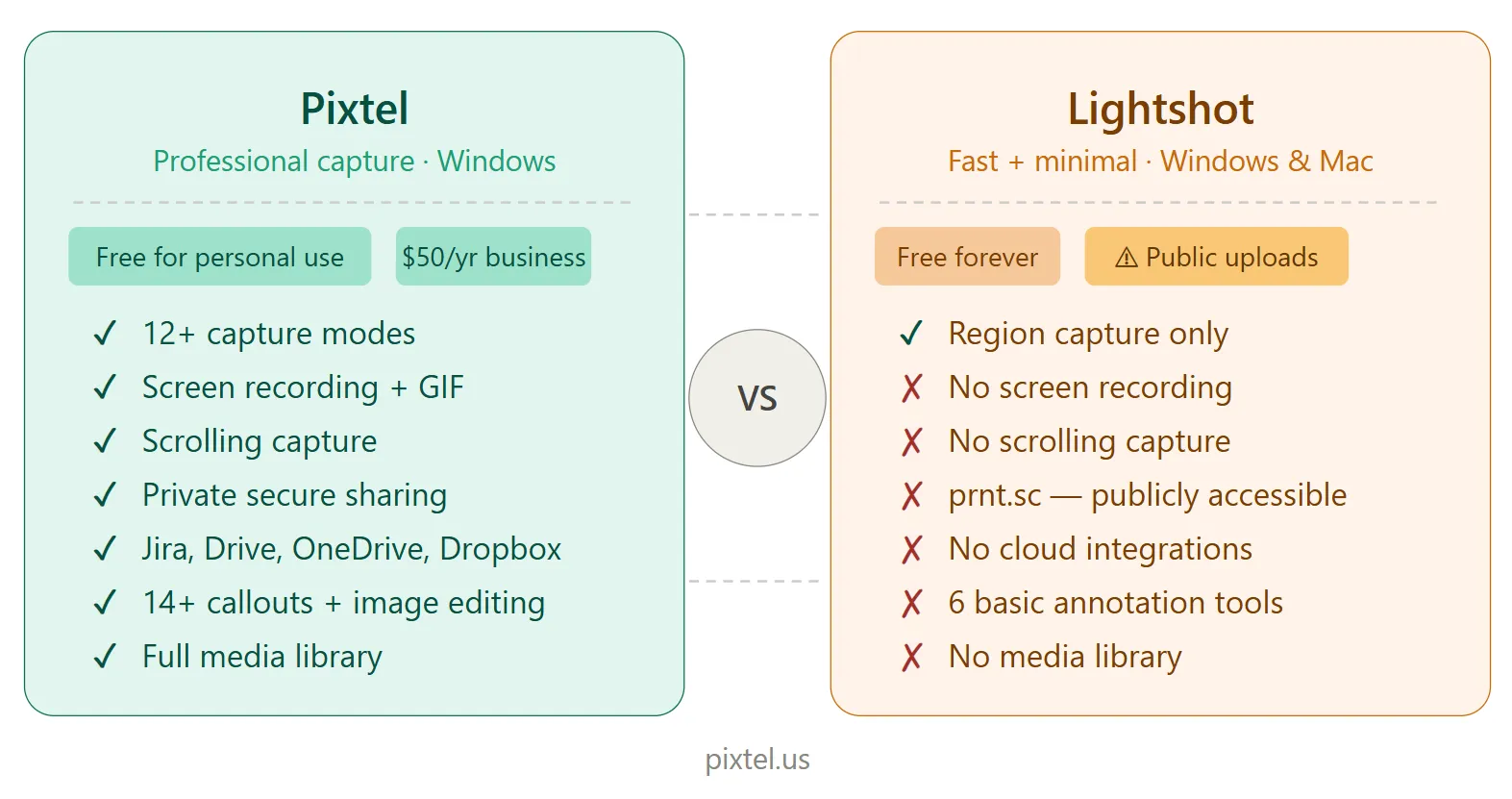
| Pixtel | Lightshot | |
|---|---|---|
| Best for | Professionals needing speed plus depth | Casual users needing quick, basic captures |
| Platform | Windows | Windows + Mac + browser extensions |
| Pricing | Free with watermarks / $25/yr (no watermarks) / $50/yr (business) | Free |
| Capture modes | 12+ | 1 (region only) |
| Scrolling capture | ✅ Yes | ❌ No |
| Screen recording | ✅ Yes | ❌ No |
| Video / GIF capture | ✅ Yes | ❌ No |
| OCR / text extraction | ✅ Advanced (table extraction) | ❌ No |
| Virtual Canvas | ✅ Yes | ❌ No |
| Image editing suite | ✅ Full | ❌ Basic shapes and text only |
| Annotation tools | 14+ callout types, sticky notes, Smart Pencil | Arrow, line, text, rectangle, colour |
| Cloud integrations | Jira, Google Drive, OneDrive, Dropbox, Box, FTP + more | prnt.sc only |
| Multiple cloud accounts | ✅ Yes | ❌ No |
| Share link privacy | ✅ Private, with auto-delete options | ⚠️ Public — anyone can guess the URL |
| Media management library | ✅ Full system | ❌ No library |
| Active development | ✅ Yes | ⚠️ Minimal updates |
| Free personal use | ✅ (watermarks on free tier) | ✅ Yes |
Overview: What Are These Tools?
Pixtel
Pixtel is a Windows-native screen capture and media management suite available on the Microsoft Store. Built for professionals — developers, QA engineers, product managers, designers, and technical writers — it combines 12+ capture modes, a full annotation and image editing suite, a Virtual Canvas, and deep integrations with tools like Jira, Google Drive, OneDrive, Dropbox, Box, and Microsoft Office.
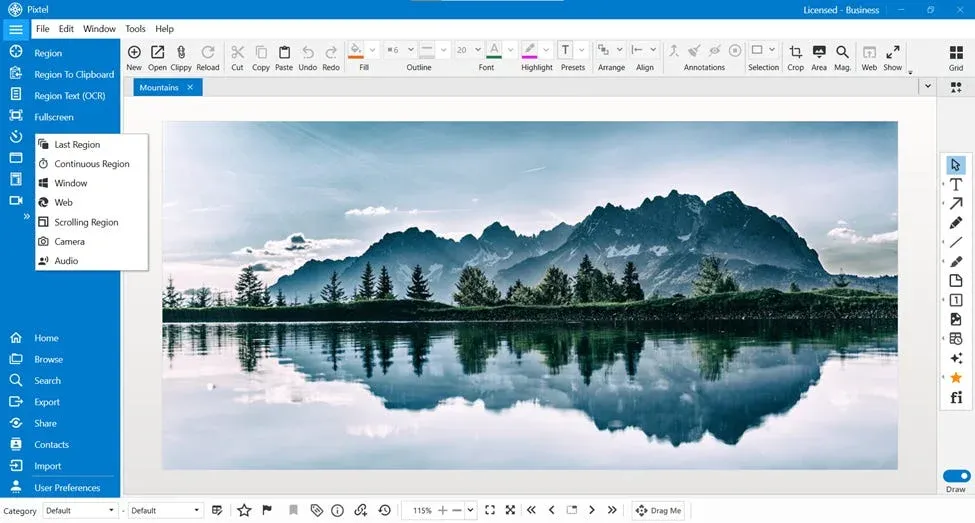
Every capture is automatically organized in a browsable media library. Sharing is private by default, with link expiry controls. The editor is clean and immediate — all tools visible, no menus to navigate, settings saved between sessions.
For personal use, Pixtel is free — all features included, with watermarks on captured images and videos. Upgrade to Personal ($25/yr) to remove watermarks.
Lightshot
Lightshot is a free, lightweight screenshot tool developed by Skillbrains, available for Windows, Mac, and as browser extensions for Chrome, Firefox, and Opera. It replaces the default Print Screen key with a drag-to-select capture interface. Select a region, add basic annotations, and either save locally or upload to prnt.sc for a shareable link.
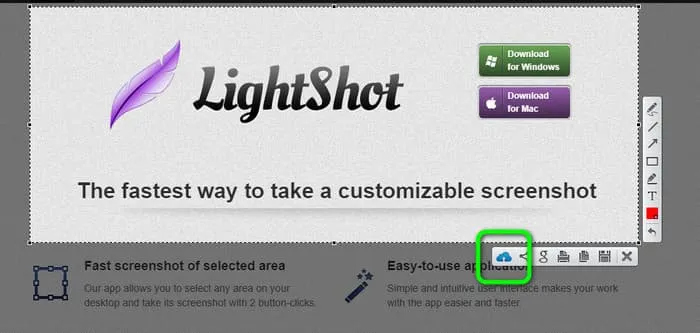 Lightshot's strengths are real: it is genuinely fast, genuinely lightweight (under 5 MB, 15–20 MB RAM at idle), and requires no setup or learning. For users who occasionally need a quick region capture with minimal fuss, it earns its following.
Its limitations are equally real. Lightshot supports one capture mode — region selection. There is no scrolling capture, no screen recording, no OCR, no media library, no integrations beyond prnt.sc, and no image editing beyond six basic tools. And its sharing model has a documented privacy problem that has affected users for years.
The Privacy Issue: What Every Lightshot User Should Know
This is the most important section of this comparison, and it is worth being direct.
When you upload a screenshot to Lightshot's prnt.sc service, it is assigned a short URL with a predictable alphanumeric pattern. These URLs are publicly accessible — there is no login required, no access control, and no encryption. Anyone who knows or guesses the pattern can browse other users' uploaded screenshots.
Security researchers have documented this extensively. Entire GitHub repositories exist to scrape prnt.sc screenshots in bulk. Kaspersky has documented active cryptocurrency scams operating on the Lightshot gallery, targeting users whose wallet credentials or private information appeared in uploaded screenshots. Passwords, private conversations, invoices, code, banking pages — anything captured and uploaded through Lightshot's cloud is potentially exposed.
This does not mean Lightshot is unusable. It means the upload feature should not be used for anything sensitive. Users who only save screenshots locally are unaffected by this issue.
But for any professional workflow — bug reports with internal system data, customer support screenshots, product documentation containing pricing or user data — Lightshot's sharing model is a meaningful risk.
Pixtel's Share Link feature generates private URLs with configurable auto-delete settings. Nothing is publicly browsable. You control who can see what, and for how long.
Capture Modes
Pixtel (12+ modes)
- Region Capture — click and drag to select any area
- Fullscreen Capture — all monitors, with or without taskbar
- Active Window Capture — isolate the current app window
- Scrolling Window Capture — capture entire scrollable windows automatically
- Scrolling Region Capture — capture a specific scrollable section within a page
- Web Capture — full webpage capture with source URL preserved
- Region to Clipboard — capture directly to clipboard without opening editor
- Clipboard as New Tab — open any clipboard image directly as a new editor tab
- Last Region — instantly re-capture the exact same screen area
- Continuous Region Capture — capture a fixed area at set intervals
- Timed Capture — countdown before capture for menus and tooltips
- Camera Capture — capture from a connected webcam
- Screen Recording — record screen, camera, or both with audio
- Audio Capture — record microphone or system audio independently
Lightshot (1 mode)
- Region Capture — drag to select a screen area
That is the complete list. Lightshot has a single capture mode. There is no fullscreen capture, no window capture, no scrolling capture, no timed capture, no screen recording, no audio capture, and no camera capture.
Users who need to capture a full webpage, a long document, a dropdown menu, or a screen recording must use a completely separate tool. For Lightshot users who have encountered any of these needs, this limitation is already familiar.
Edge: Pixtel — categorically. Lightshot's single capture mode covers the simplest use case only.
Annotation and Editing
Pixtel
Pixtel's annotation toolkit covers the full professional range:
- Arrows, lines, shapes (rectangles, ellipses, polygons, freehand)
- Text boxes, callouts (14 callout types), sticky notes
- Blur for redacting sensitive data, highlights, borders
- Stamps, rubber stamps, timestamps, clickable links
- Smart Pencil — converts rough freehand drawings into clean geometry
- Counter/step numbering for sequential screenshots
- Crop, Magnifier, Embedded Image
- Virtual Canvas — extend annotation space infinitely beyond image boundaries
Beyond annotation, Pixtel includes a complete image editing suite that eliminates the need to open Photoshop or Paint:
- Brightness and Contrast adjustment
- Hue, Saturation, and Color Balance
- Convert to Grayscale / Black & White
- Sharpen and Blur
- Image Effects (solarize, mosaic, tile, motion blur)
- Canvas Resize and Image Resize
- Flip, Rotate, Color Picker, Invert Colors
- Watermark — embed a custom watermark image into any capture for branding or attribution
Editor UX: All tools are always visible around the window. Clicking a tool opens a popup panel showing all style variants. The top bar surfaces relevant controls as quick dropdowns, and selections are saved for the next annotation. Double-clicking any annotation opens a precise properties panel. The full canvas stays uncluttered.
Lightshot
Lightshot's annotation tools are available during the capture itself — before you save or upload:
- Pen (freehand drawing)
- Line
- Arrow
- Rectangle
- Text
- Colour selector
That is the complete toolkit. There are no callouts, no sticky notes, no blur for redaction, no step numbering, no Smart Pencil, no Virtual Canvas, and no image editing beyond these six tools. Once a screenshot is saved or uploaded, there is no way to re-open it in Lightshot's editor for further changes.
Users on review platforms consistently flag this: "I'd like more editing features" and "annotation options are basic" are among the most commonly repeated criticisms.
Edge: Pixtel — not close. Lightshot's six annotation tools cover the most basic markup needs. Pixtel's full annotation suite plus image editing suite covers everything a professional might need without leaving the app.
Screen Recording and Video
Pixtel includes full screen recording with audio — capture your screen, webcam, or both simultaneously. Screen recordings open in the same media library as screenshots. Pixtel also supports independent audio capture and GIF recording.
Lightshot cannot record anything. No video, no audio, no GIF. If you need to record a workflow, demonstrate a bug, or create any kind of visual walkthrough, you need a completely separate application.
Edge: Pixtel — categorically. Lightshot has no recording capability of any kind.
OCR and Text Extraction
Pixtel includes advanced OCR that extracts plain text from any image or screenshot, and can extract structured table data directly into spreadsheet format. The Region Text Capture mode pulls text from any area of your screen on the fly — ideal for copying content from PDFs, legacy systems, or locked-down web pages.
Lightshot has no OCR capability. Extracting text from a screenshot requires a completely separate tool.
Edge: Pixtel — Lightshot has no equivalent feature.
Sharing and Integrations
Pixtel
- Share Link — generate a private, shareable URL with configurable auto-delete settings
- Jira — native integration to attach annotated screenshots directly to issues
- Google Drive — single or bulk upload; multiple accounts supported
- OneDrive — direct upload; multiple accounts supported
- Dropbox — folder selection, bulk upload; multiple accounts supported
- Box — enterprise cloud upload; multiple accounts supported
- FTP — multiple server configurations supported
- Email — via configured email with OAuth2
- OneNote — clip directly into notebooks
- Evernote — capture to notes
- YouTube — publish screen recordings directly
- Vimeo — upload videos without switching apps
- Microsoft Office — export to Word, PowerPoint, and Excel
- Drag Me — drag images directly into any app without saving
Pixtel supports multiple accounts per cloud service — connect several Google Drive, OneDrive, or Dropbox accounts and switch between them in a single click.
Lightshot
- prnt.sc — upload to Lightshot's public image hosting server for a shareable link
- Social media — share directly to Pinterest, Facebook, Twitter
- Clipboard — copy to clipboard
- Local save — save to disk as PNG, JPG, or BMP
- Print — send directly to printer
- Search similar — search Google for visually similar images
Lightshot's sharing ecosystem is built entirely around its own prnt.sc service, social media, and clipboard. There is no integration with any professional productivity tool — no Google Drive, no Dropbox, no OneDrive, no Jira, no Office, no email client. For teams that share screenshots as part of structured workflows — bug tracking, documentation, client communication — this forces a manual export step every time.
Edge: Pixtel — not comparable for professional workflows. Lightshot's strength is frictionless public sharing for casual use. Pixtel's strength is secure, flexible sharing into the tools your team already uses.
Media Management
Pixtel maintains a complete media library for every capture:
- Browsable thumbnail grid view
- Filter by type (image, video, audio)
- Date-based browsing and search
- Tags and bulk operations (export, collage, delete)
- Recycle bin for accidental deletions
- Backup, restore, and data relocation tools
- Duplicate detection and cleanup
- Automatic organization by source application or website
Lightshot has no media library. It maintains a screenshot history accessible from the system tray, but this is a basic list — not a browsable library with thumbnails, search, tags, or bulk management. Screenshots saved locally are just files in a folder.
Edge: Pixtel — Lightshot has no equivalent for managing screenshots at any meaningful volume.
Speed and Simplicity
This is where Lightshot's genuine strengths deserve honest recognition.
Lightshot is extraordinarily fast and simple. Press PrtScn, drag, annotate if needed, upload or save — the entire workflow takes under ten seconds and requires zero configuration. The app weighs under 5 MB, uses 15–20 MB of RAM at idle, and is invisible until you need it. There is no launcher, no workspace, no tabs, no library to manage. For users who take occasional screenshots and need nothing more, this frictionlessness is genuinely valuable.
Pixtel is also designed to be fast. The system tray integration means capture is always one keystroke away, captures open immediately in a new tab, and the always-visible toolbar means annotations take seconds. For quick region captures with immediate clipboard output, Pixtel matches Lightshot's speed.
The difference is what happens after the capture. Lightshot's workflow ends at save or upload. Pixtel's workflow continues into annotation, editing, organization, and sharing into professional tools — for users who need that, without slowing down the users who don't.
Edge: Lightshot for absolute minimalism. Edge: Pixtel for speed combined with professional depth.
Who Should Use Pixtel?
Pixtel is the right choice if you:
- Need scrolling capture for long webpages or documents
- Need screen recording alongside screenshots in the same workflow
- Work in development or QA and need native Jira integration
- Handle high volumes of screenshots and need a real media library
- Need secure, private sharing with link expiry — not a public upload gallery
- Want to edit images (brightness, contrast, grayscale, canvas resize) without opening another app
- Use multiple cloud accounts across Google Drive, OneDrive, or Dropbox
- Need to extract text or table data from screenshots via OCR
- Want a clutter-free editor with always-visible tools and persistent annotation settings
- Need timed capture for dropdown menus or tooltips
Who Should Keep Using Lightshot?
Lightshot remains a reasonable choice if you:
- Only ever need quick, occasional region captures with no further workflow
- Share screenshots casually and are comfortable with public prnt.sc links
- Are on older hardware and want the absolute minimum footprint
- Primarily use Mac or a browser extension rather than a dedicated Windows app
- Need to search for visually similar images on Google from a screenshot (a unique Lightshot feature)
If any of Lightshot's limitations — no scrolling capture, no recording, no private sharing, no integrations — have caused friction, those limitations are structural. Lightshot is a single-purpose capture tool and is unlikely to grow beyond that.
Feature Comparison: Full Table
| Feature | Pixtel | Lightshot |
|---|---|---|
| Platform | Windows | Windows, Mac, browser |
| Pricing | Free with watermarks / $25/yr (no watermarks) / $50/yr (business) | Free |
| Active development | ✅ | ⚠️ Minimal |
| Region capture | ✅ | ✅ |
| Fullscreen capture | ✅ | ❌ |
| Window capture | ✅ | ❌ |
| Scrolling capture | ✅ | ❌ |
| Last Region | ✅ | ❌ |
| Continuous/interval capture | ✅ | ❌ |
| Timed/delayed capture | ✅ | ❌ |
| Camera capture | ✅ | ❌ |
| Screen recording | ✅ | ❌ |
| GIF recording | ✅ | ❌ |
| Audio capture | ✅ | ❌ |
| Clipboard as new tab | ✅ | ❌ |
| Arrow / line annotation | ✅ | ✅ |
| Text annotation | ✅ | ✅ |
| Rectangle / shape | ✅ | ✅ |
| Callout types | 14 | ❌ |
| Sticky notes | ✅ | ❌ |
| Blur / redaction | ✅ | ❌ |
| Step / counter numbering | ✅ | ❌ |
| Smart Pencil | ✅ | ❌ |
| Virtual Canvas | ✅ | ❌ |
| Image editing suite | ✅ Full | ❌ None |
| Brightness / contrast | ✅ | ❌ |
| Grayscale / B&W | ✅ | ❌ |
| Canvas resize | ✅ | ❌ |
| Image effects | ✅ | ❌ |
| Color picker | ✅ | ❌ |
| Watermark (custom image) | ✅ | ❌ |
| Editor UX | Popup panels, persistent settings | Inline toolbar during capture only |
| OCR text extraction | ✅ Advanced | ❌ |
| Table data extraction | ✅ | ❌ |
| Media library | ✅ Full system | ❌ Basic history list |
| Backup and restore | ✅ | ❌ |
| Share link privacy | ✅ Private + expiry | ⚠️ Public (prnt.sc) |
| Jira integration | ✅ Native | ❌ |
| Google Drive | ✅ | ❌ |
| OneDrive | ✅ | ❌ |
| Dropbox | ✅ | ❌ |
| Box | ✅ | ❌ |
| Multiple cloud accounts | ✅ | ❌ |
| FTP | ✅ | ❌ |
| ✅ | ❌ | |
| Microsoft Office export | ✅ | ❌ |
| Social media sharing | ❌ | ✅ |
| Similar image search | ❌ | ✅ |
| Clipboard copy | ✅ | ✅ |
| Local save | ✅ | ✅ |
| Collage / image layouts | ✅ | ❌ |
| Slideshow / presentation mode | ✅ | ❌ |
| Browser extension | ❌ | ✅ |
| Free personal use | ✅ (watermarks on free tier) | ✅ |
The Bottom Line
Lightshot earns its reputation for one specific thing: getting a screenshot from your screen to someone else's eyes as fast as possible, with zero friction. For casual, occasional captures where speed is the only requirement, it still does that well.
But for Windows professionals in 2026, Lightshot's single capture mode, six annotation tools, no recording, no OCR, no integrations, no media library, and a public sharing model with documented privacy risks make it a tool that most users will eventually outgrow — often the moment they need to capture a long webpage, share a screenshot privately, or find something they captured three weeks ago.
Pixtel matches Lightshot's speed for quick region captures and builds everything else around it — 12+ capture modes, a full annotation and image editing suite, native Jira integration, private shareable links, a complete media library, and multi-account cloud support. And like Lightshot, the basic tier is free — though Pixtel's free tier adds watermarks to captures (removed from $25/yr), while Lightshot has no watermarks.
If Lightshot has ever left you needing a second tool for something it couldn't do, Pixtel is the single tool that replaces both.
Try Pixtel Free Today
👉 Download Pixtel
🎥 Follow us on YouTube
📘 Read Detailed Documentation
'%3e%3cpath%20d='M6.49988%200.862305L0.380969%206.98121C-0.127315%207.4895%20-0.127315%208.31107%200.380969%208.81936C0.889253%209.32764%201.71083%209.32764%202.21911%208.81936L5.19992%205.83855V15.7C5.19992%2016.4176%205.781%2017%206.49988%2017C7.21875%2017%207.79984%2016.4176%207.79984%2015.7V5.83855L10.7806%208.81936C11.0341%209.07285%2011.3669%209.20024%2011.6997%209.20024C12.0325%209.20024%2012.3653%209.07285%2012.6188%208.81936C13.1271%208.31107%2013.1271%207.4895%2012.6188%206.98121L6.49988%200.862305Z'%20fill='white'/%3e%3c/g%3e%3cdefs%3e%3cclipPath%20id='clip0_1_2'%3e%3crect%20width='13.0002'%20height='16.8995'%20fill='white'%20transform='translate(-0.000244141%200.100533)'/%3e%3c/clipPath%3e%3c/defs%3e%3c/svg%3e)